Travelling to the Basque Country means visiting Saint-Jean-Pied-de-Port : one of those towns that leaves a mark on everyone who passes through — and not only because it stands at the start of a path 780 kilometres long..
Saint-Jean-Pied-de-Port: Complete Guide to the Medieval Basque Town
A fortified medieval town at the foot of the Pyrenees, a crossroads of civilisations between France and Spain, a Basque town to its core and a gateway to the world for hundreds of thousands of pilgrims, Saint-Jean-Pied-de-Port (Donibane Garazi in Basque) packs into a few narrow streets a density of history, culture and emotion that few places in France can match.
This complete guide covers everything you need to know: its thousand-year history, its living Basque culture, its inseparable link with the Camino de Santiago, its must-sees and how to get there from Biarritz.
Saint-Jean-Pied-de-Port at a Glance
📍 Where: Pyrénées-Atlantiques (64), French Basque Country — 150 km from Biarritz, 53 km from Bayonne
🏰 What to see: pink sandstone ramparts, Rue de la Citadelle, Porte Saint-Jacques (UNESCO), Vauban citadel, Old Bridge over the Nive
🎒 Camino: historic starting point of the Camino Francés — 250,000 to 300,000 pilgrims per year
🗓️ Best time to visit: April-June and September-October — pleasant weather, manageable crowds
🚖 From Biarritz: Smart Moov taxi in 1h30-1h45, fixed fare from €150 · Bus line 816 via Bayonne (2h30, limited timetables)
🛏️ Accommodation: pilgrim hostels €15-25 · B&Bs €40-80 · hotels €60-150 — book well in advance in high season
To reach Saint-Jean-Pied-de-Port from Biarritz or BIQ Airport, Smart Moov provides your Biarritz to Saint-Jean-Pied-de-Port taxi — fixed fare, luggage welcome, available 24/7.
Saint-Jean-Pied-de-Port: Location and Natural Setting
Saint-Jean-Pied-de-Port lies in the Pyrénées-Atlantiques department, in the Nouvelle-Aquitaine region, at the south-eastern edge of the French Basque Country.
The town sits in a natural hollow at the confluence of the Nive, the Arnéguy and the Eyheraberry rivers, at an altitude of 163 metres — modest compared to the peaks that rise sharply to the south, where the Pyrenees climb quickly towards the Col de Roncevaux (1,057 m) and the Col de Lepoeder (1,450 m).
This singular position — “at the foot of the ports”, ports meaning mountain passes in Old French — is precisely what gives the town its name.
As the crow flies, it sits approximately 140 kilometres from Biarritz, 53 kilometres from Bayonne and just a few hundred metres from the Spanish border. By car or taxi from Biarritz, the D918 then the D933 wind through Iparralde (the French Basque Country), climbing gradually through rolling green hills, traditional Basque farmhouses and picturesque villages. The journey takes 1h30 to 1h45 — one of the most beautiful drives in the Basque Country.
The natural setting is striking in every season. Lush and flowering in spring, warm and golden in summer, spectacularly colourful in autumn, occasionally snow-capped in winter — the landscape is one of the town’s greatest assets.
History of Saint-Jean-Pied-de-Port: a Thousand Years at Europe’s Crossroads
Medieval origins and the royal town of Navarre
The history of Saint-Jean-Pied-de-Port begins in the 12th century, when the kings of Navarre founded a fortified town to control the Pyrenean crossing at the Col de Roncevaux.
Built on a rocky outcrop overlooking the confluence of the rivers, the town quickly became a toll point and strategic gateway on the road to Pamplona and Madrid.
Throughout the Middle Ages it flourished as a commercial and military crossroads. Merchants, soldiers, diplomats and pilgrims crossed paths here, lodged and exchanged goods. The town welcomed a significant community of Sephardic Jews who played a key role in regional trade, as well as Frankish settlers attracted by the privileges granted by the Navarrese kings — an early cosmopolitanism that became one of its defining characteristics.
Between France and Spain: a contested border
The annexation of Upper Navarre by Castile in 1512, then of Lower Navarre (to which Saint-Jean belonged) by France in 1620 under Louis XIII, placed the town on the frontier between two rival powers.
Taken and retaken through successive Franco-Spanish conflicts, it saw Napoleon’s armies pass through during the Peninsular War (1808-1814) — an episode that left a lasting mark on local memory and gave its name to the Route Napoléon followed by Camino pilgrims today.
The Vauban citadel and the pink ramparts
The citadel crowning the town is one of its most remarkable monuments. Built on the heights above the old town according to Vauban’s principles in the late 17th century, it offers a sweeping panoramic view over the slate rooftops, the ramparts and the first Pyrenean ridgelines.
The ramparts themselves, built from local pink sandstone, give the town its characteristic warm rose colour — one of the most photographed sights in the Basque Country, particularly at sunset.
The Porte Saint-Jacques, set into these ramparts, has been a UNESCO World Heritage Site since 1998.
Saint-Jean-Pied-de-Port and Basque Culture
Donibane Garazi — a Basque town to its core
Donibane Garazi — that is the Basque name for Saint-Jean-Pied-de-Port, meaning literally “Saint John of the Garazi valley”.
Basque is a living language here, spoken daily by a significant part of the population and present throughout the street names, shop signs and local life. The town is the historic capital of the province of Lower Navarre (Nafarroa Beherea) — one of the seven provinces of the Basque Country.
Basque architecture: red and green timber frames
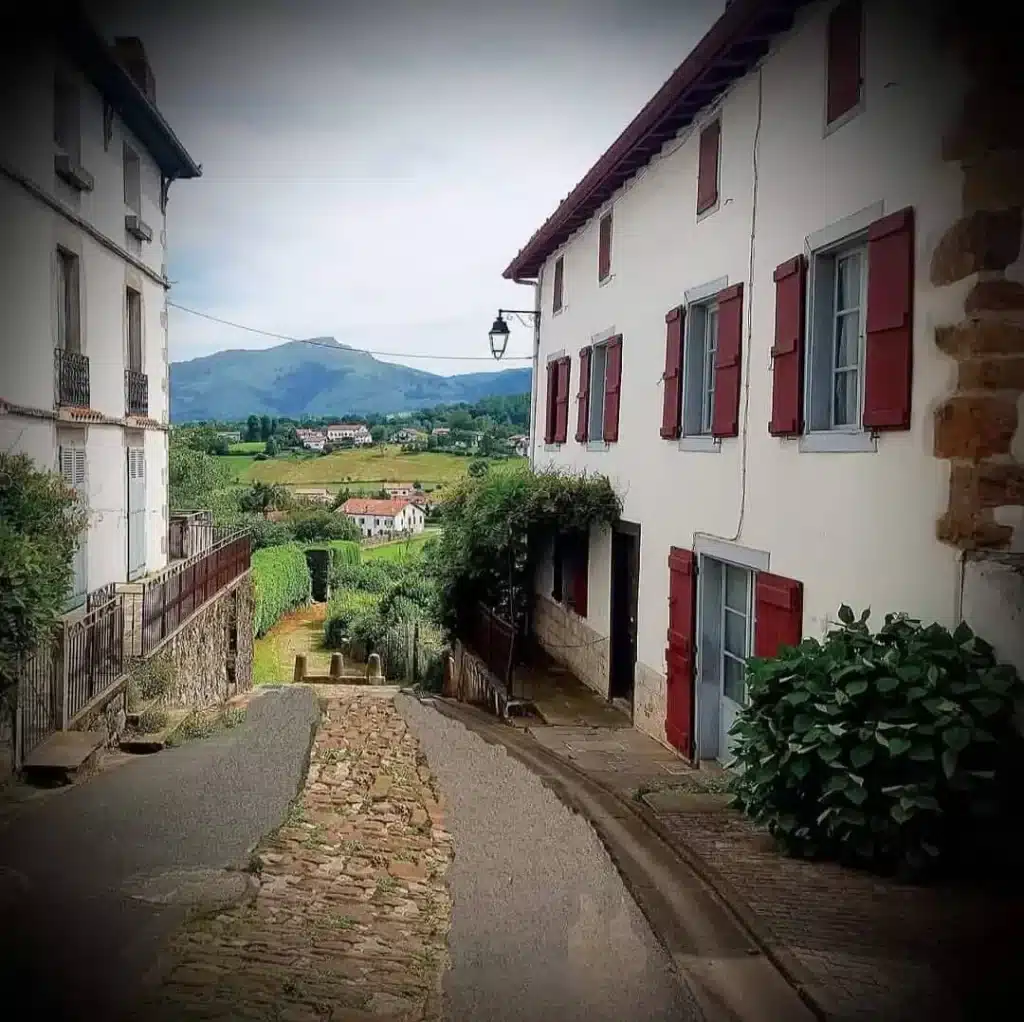
The old town is a concentrated showcase of traditional Basque architecture at its finest.
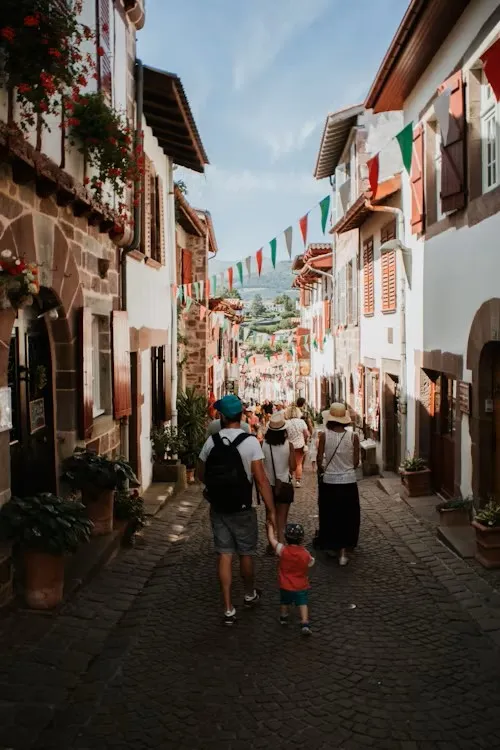
The half-timbered houses — wooden frames painted in deep red or green — line the Rue de la Citadelle and the adjacent lanes. Basque tradition distinguishes the two colours by facade: red for corner walls and doors, green for windows and shutters.
The local sandstone ground floors, flower-decked balconies and distinctive gable ends compose a coherent and photogenic urban ensemble that has resisted centuries and trends alike.
Pelota and local traditions
Saint-Jean-Pied-de-Port is a town where Basque traditions are not stage dressing for tourists — they are lived.
Basque pelota (pilota) has been played at the open-air fronton for generations: Sunday afternoon matches still draw locals in a genuinely authentic atmosphere. The patronal feast of Saint John in June, the Monday weekly market, traditional dances at local festivals — the collective life of the town resists tourist seasonality.
Euskara — the language of the Pyrenees
Euskara — the Basque language — is one of the most mysterious languages in Europe: a linguistic isolate with no known relation to any other language in the world, predating Indo-European in this region and surviving every successive occupation and domination.
In Saint-Jean-Pied-de-Port, it is taught in ikastola (Basque-language schools), used in public signage and present in the daily life of the community. Its survival in the Garazi valley is a remarkable testament to the cultural resilience of a people who never had a state but preserved their soul through their language.
Saint-Jean-Pied-de-Port and the Camino de Santiago
A pilgrimage crossroads since the Middle Ages
Saint-Jean-Pied-de-Port is inseparable from the Camino de Santiago.
Since the Middle Ages, the town has been the final gathering point for pilgrims from across Europe before the crossing of the Pyrenees. The four great French pilgrimage routes described in the 12th-century Codex Calixtinus — from Tours, Vézelay, Le Puy-en-Velay and Arles — all converge here before crossing the mountains together.
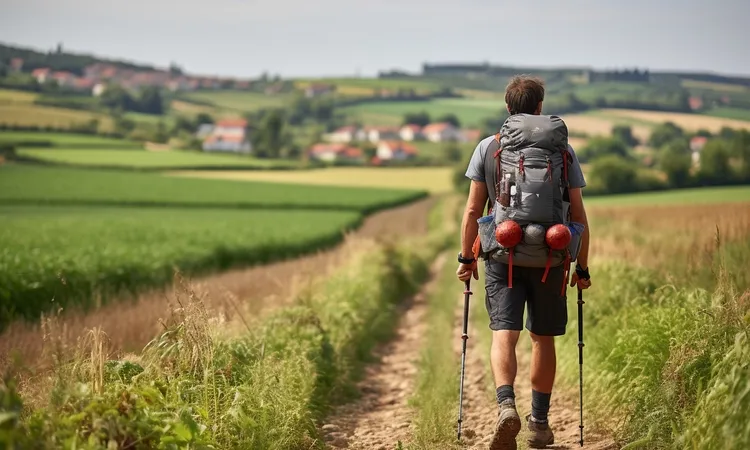
This convergence makes the town the historic starting point of the Camino Francés, the route that leads 780 km to Santiago de Compostela.
The revival of the pilgrimage and UNESCO recognition
After several centuries of decline, the Camino experienced a spectacular revival from the 1980s onwards.
In 1987, the Council of Europe proclaimed it “the first European Cultural Itinerary”. In 1993, the Spanish section was inscribed as a UNESCO World Heritage Site. In 1998, the French routes — including those converging on Saint-Jean — received the same recognition.
Since then, pilgrim numbers have grown continuously: from a few thousand per year in the 1990s to over 400,000 Compostelas issued in Santiago in 2023.
The Pilgrims’ Welcome Office — the living heart of the Camino
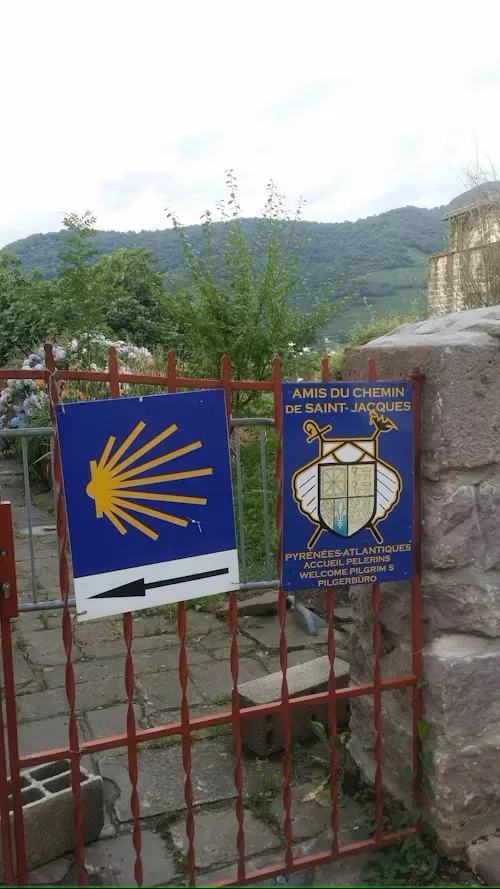
The heart of the pilgrim experience in Saint-Jean is the Pilgrims’ Welcome Office, run by the association Côte Saint-Jacques, at 39 Rue de la Citadelle.
This is where pilgrims obtain or have their credential stamped (the pilgrim passport), receive information on weather conditions and trail status, and truly begin their journey.
Multilingual volunteers welcome arrivals daily with consistent warmth. The atmosphere is unique: international, supportive, charged with a collective emotion that is palpable at any time of day.
The Porte Saint-Jacques and the Rue de la Citadelle
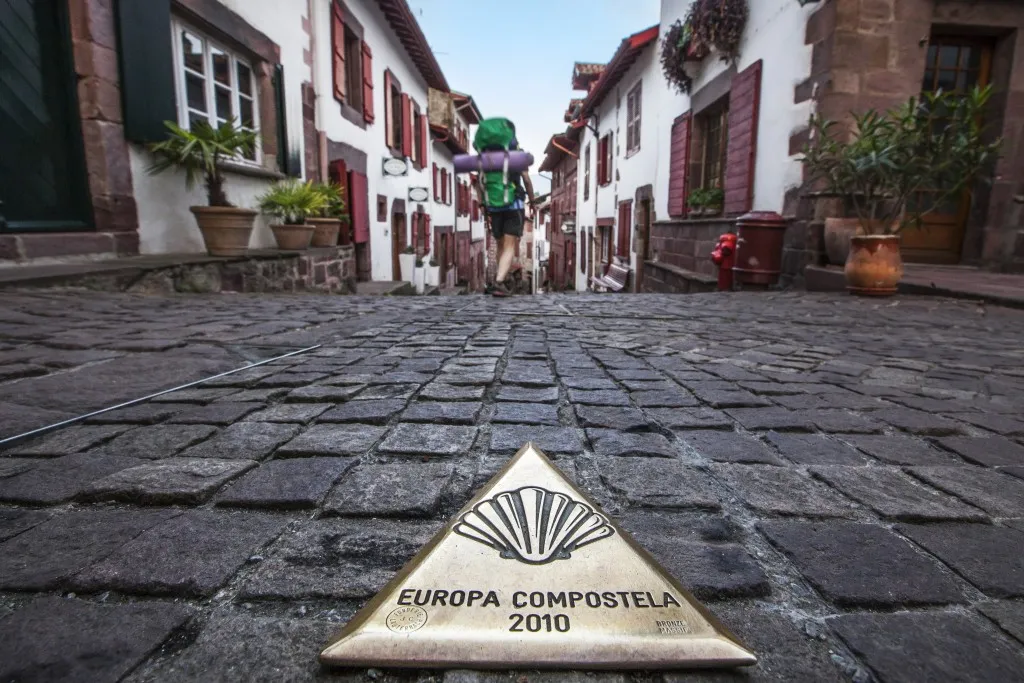
The Porte Saint-Jacques — set into the pink ramparts at the foot of the Rue de la Citadelle — is the symbolic threshold every pilgrim crosses at the start of the Camino Francés.
A UNESCO World Heritage Site, this medieval gate opens directly onto the path leading up to Roncevaux. Stepping through it with a backpack is a solemn moment, laden with meaning for those setting off — and strangely moving even for visitors who simply understand its significance.
The Rue de la Citadelle, running from the citadel down to this gate past the town’s finest half-timbered houses, is the main artery of pilgrim life: Camino gear shops, hostels, restaurants, pilgrim offices and small chapels follow one another over just a few hundred metres.
Things to Do in Saint-Jean-Pied-de-Port
Explore the old town and the citadel
Any visit naturally begins with the old town — just a handful of streets, but of remarkable architectural and historical density.
The Rue de la Citadelle, Rue d’Espagne, Rue de la Poterne and their side lanes form an intact medieval urban fabric. The citadel, reached on foot from the centre via a steep path, offers a 360° panoramic view over the valley, the Nive and the first Pyrenean ridgelines.
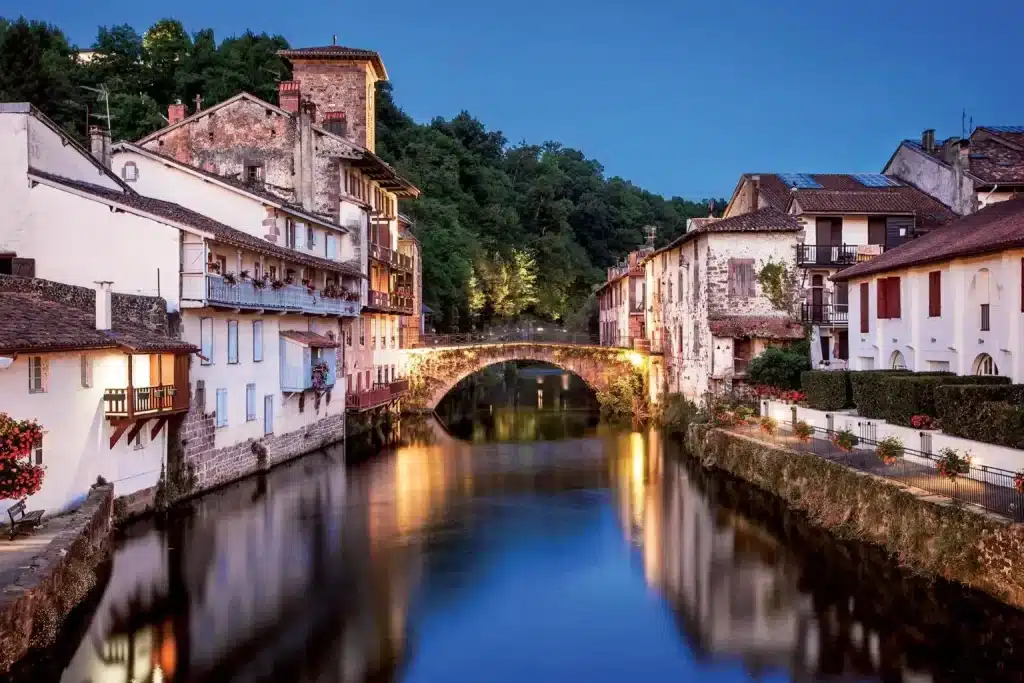
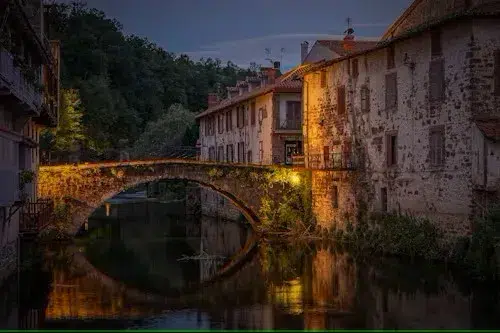
The Old Bridge over the Nive, whose medieval arch reflects in the clear river water, is one of the town’s unmissable photography spots.
The Monday market
The weekly Monday market is one of the most authentic in the Basque interior.
Local producers, valley farmers, Basque craftspeople and travelling traders gather in the town centre for a morning of commerce and rural sociability that has barely changed in centuries.
Sheep’s cheese (including Ossau-Iraty PDO), Bayonne ham, garden vegetables, Pyrenean honey, traditional Basque textiles — this is where you find the finest mountain produce at fair prices, far from tourist gimmickry.
Hiking and outdoor activities
Saint-Jean-Pied-de-Port is an excellent base for hiking in the Basque Pyrenees, even for those not doing the Camino.
Waymarked trails lead to the surrounding ridgelines as a day walk, with exceptional views across both sides of the Pyrenees. The Nive valley downstream offers gentler walks along the river, ideal for families. In summer, swimming in the Nive is a long-standing local tradition.
Mountain Basque gastronomy
The cuisine of Saint-Jean-Pied-de-Port is that of the Basque interior — more rustic than the coastal gastronomy of Biarritz, but authentically rich.
Tripotx (a pork offal black pudding) is the quintessential local speciality. Ossau-Iraty PDO sheep’s cheese, made in the surrounding high pastures, is paired with Itxassou black cherry jam in a typically Basque sweet-savoury combination. Nive trout, caught in the river running through the town, appears in several forms on restaurant menus.
Basque chicken with piperade, ttoro (Basque fish soup), axoa de veau — the local tables reflect a solid gastronomic identity rooted in the produce of the mountain terroir.
How to Get to Saint-Jean-Pied-de-Port from Biarritz and Bayonne
Saint-Jean-Pied-de-Port is approximately 150 kilometres from Biarritz and 53 kilometres from Bayonne. Several transport options are available depending on your profile and constraints.
Taxi from Biarritz — the direct solution
For pilgrims carrying full gear or visitors who want to arrive without timetable constraints, the Biarritz to Saint-Jean-Pied-de-Port taxi with Smart Moov is the most comfortable solution.
Pick-up from BIQ Airport, your hotel or Bayonne station. Drop-off at the Pilgrims’ Welcome Office or your hostel. Fixed fare from €150, van available for groups, flight tracking for airport arrivals. Journey time: 1h30 to 1h45.
Discover diefferent options on how to get from Biarritz to Saint Jean Pied de Port.
Bus from Bayonne — the budget option
Transdev Pays Basque line 816 connects Bayonne station to Saint-Jean-Pied-de-Port in approximately 1h30.
From Biarritz, first take a SNCF train to Bayonne (10-15 minutes), then board the coach. Departures are infrequent — 2 to 3 per day on weekdays, reduced at weekends. Always check timetables before planning, especially out of season.
For a full comparison of all options, see our guide how to get from Bayonne to Saint-Jean-Pied-de-Port.
Practical Information for Visiting Saint-Jean-Pied-de-Port
When is the best time to visit?
The town is open and lively year-round, but the most pleasant periods vary depending on what you are looking for.
Spring (April-June) — ideal for pilgrims and hikers. Nature in bloom, trails in good condition, reasonable visitor numbers.
Summer (July-August) — high season. Festive atmosphere at its peak, but hostels fully booked weeks in advance and heavy crowds.
Autumn (September-October) — the favourite period for regulars. Spectacular colours, gentle temperatures, reduced crowds.
Winter (November-March) — an authentic town stripped of tourist flow, but weather can be severe in the mountains and some services are reduced.
Accommodation in Saint-Jean-Pied-de-Port
The offer is varied and suited to all profiles.
Pilgrim hostels (refugios) — dormitory beds at €15-25 per night, accessible only to credential holders.
B&Bs and auberges — €40-80, often with a table d’hôtes dinner included, for more comfort and privacy.
Hotels — €60-150, few in number but good quality for a town of this size.
In high season, booking several days — sometimes several weeks — in advance is essential.
FAQ — Saint-Jean-Pied-de-Port
Why is it called Saint-Jean-Pied-de-Port?
The name means “Saint John at the foot of the passes” — the word ports meaning mountain passes in Old French. The town sits at the foot of the Col de Roncevaux and the other Pyrenean crossings between France and Spain. In Basque, it is called Donibane Garazi — “Saint John of the Garazi valley”.
Is Saint-Jean-Pied-de-Port in France or Spain?
In France, in the Pyrénées-Atlantiques department, in the French Basque Country (Iparralde). The Spanish border is a few kilometres to the south, at the Col de Roncevaux. The town is the historic capital of the province of Lower Navarre.
How many pilgrims set off from Saint-Jean-Pied-de-Port each year?
Approximately 250,000 to 300,000 pilgrims pass through the Pilgrims’ Welcome Office each year to begin the Camino Francés. Numbers have surged since the 2000s, driven by the growth of hiking tourism and a growing attraction to slow, contemplative travel.
What are the absolute must-sees in Saint-Jean-Pied-de-Port?
The Rue de la Citadelle and its red and green half-timbered houses. The Porte Saint-Jacques, a UNESCO World Heritage Site. The citadel and its Pyrenean panorama. The Old Bridge over the Nive. The Pilgrims’ Welcome Office at 39 Rue de la Citadelle. The Monday morning market. And for those with time: the first few kilometres of the path towards Roncevaux, to feel the unique atmosphere of the Camino’s departure.
Find our page Biarritz to Saint-Jean-Pied-de-Port taxi · our guide how to get from Biarritz to Saint-Jean · our article Saint-Jean-Pied-de-Port and the Camino Francés · and our article Saint-Jean → Roncevaux, the first stage.